The 100-Yard Rule: How Close Can You Get to a Whale in Maui?
Hawaii's humpback approach rules: 100 yards by boat, kayak, board or swimming, 1,000 feet by air, no cutting in front. Can you touch a whale? Is it ethical?
No closer than 100 yards, by any means: boat, kayak, paddleboard or swimming. Aircraft, including tour planes and helicopters, must stay 1,000 feet away. That is federal law in Hawaiian waters, all year, out to 200 nautical miles from the islands, and every whale-watching boat on Maui works under it. When a whale chooses to come closer, the boat is not breaking the rule; it stops and waits.
The rules, as written
The approach rules for humpback whales in Hawaii took their final form on January 22, 2024 (NOAA Fisheries). They prohibit:
- approaching within 100 yards of a humpback whale by any means;
- causing a vessel, person or other object to come within 100 yards;
- approaching by interception: placing yourself in a whale’s path so that it surfaces within 100 yards;
- disrupting a whale’s normal behaviour by any act or omission;
- operating an aircraft within 1,000 feet of a humpback whale.
Government vessels on duty, boats avoiding an immediate danger, vessels with restricted ability to manoeuvre and activities under a NOAA permit are exempt. Violations can be reported to the NOAA Fisheries enforcement hotline, 1-800-853-1964.
What boats do on top of the law
The Hawaiian Islands Humpback Whale National Marine Sanctuary and the state’s boating division ask boaters to “Go Slow, Whales Below”: a top speed of 15 knots in water up to 600 feet deep, where whales gather, and no more than 6 knots within 400 yards of a whale, leaving the area the way they came. They also ask every boat to post a lookout from November through May. These are voluntary, but they are the standard the reputable operators keep, and the reason a whale watch slows right down as it nears a pod.
Can you touch a whale if it swims up to you?
No. Touching would mean being well inside 100 yards, and swimmers, snorkellers and paddlers are bound by the same rule as boats. If a whale surfaces near you in the water, move away calmly. On a boat, the crew will stop, put the engines in neutral and let the whale move on in its own time.
Do whale-watching boats bother whales?
They can, which is exactly what the rules are written to prevent: the ban on interception and on disrupting behaviour exists because boats that chase or crowd whales do change what the whales do. A boat that keeps 100 yards off, approaches slowly from the side or behind and leaves the way it came gives the whales the choice. That is also how the best encounters happen: a curious whale, often a young one, comes over to a stopped boat.
Is whale watching ethical?
Watched this way, it is widely treated as the low-impact way to see humpbacks, and on Maui it has a direct conservation link. Pacific Whale Foundation, a nonprofit, puts the profits from its whale watches into research, education and conservation, and its volunteers run the Great Whale Count each winter: 847 sightings off Maui on February 28, 2026. Ultimate Whale Watch is a certified first responder to whale entanglements. Choosing operators with naturalists on board, and steering clear of anything that promises to swim with or touch whales, is the practical test.
What it means for your trip
A raft does not get you nearer than a catamaran: both stop at 100 yards. What a raft changes is your height, so a whale that does come close is at eye level; a catamaran’s upper deck sees farther across the water. Hydrophones let you hear the whales under the boat at any distance; the songs come from the males, in sessions that run from a few minutes to more than a day (NOAA).
For eye level, Hawaii Ocean Rafting's small raft from north Lahaina is the most-reviewed whale watch on Maui, rated 4.9 from 2,859 reviews, from $85.16 a person for 90 minutes (checked October 2026).
The raft or catamaran guide compares the two, and kayakers will find the guided kayak whale watch on the Kihei page.
The behaviours you may see
- Blow: the spout as a whale exhales; adults breathe every 10 to 15 minutes and can stay down for up to 45, calves every 3 to 5.
- Breach: the whole body launched out of the water and crashing back.
- Tail slap and pectoral slap: a fluke or one of the long side fins, a third of the body length, slapped on the surface.
- Spy hop: the head raised slowly and vertically out of the water.
- Fluke-up dive: the tail lifted clear as a whale goes deep.
- Competition pod: several males chasing and jostling for a female, with head lunges and bubble trails. Whales in a competition pod rarely breach.
More on the Water
Other Maui Boat Trips with Open Dates
Snorkel, sunset and whale-watch trips around Maui with live availability. Times and cancellation terms are on each listing.
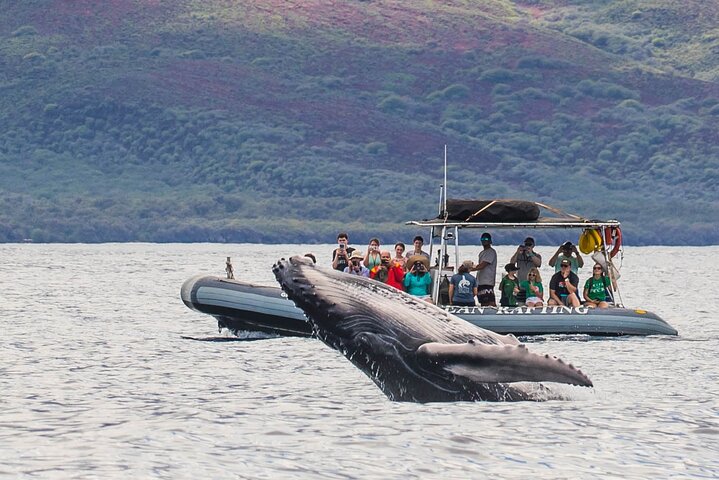
Let the Whale Come to You
Hawaii Ocean Rafting's small raft from the Mala ramp keeps its distance and stops when a whale approaches. A naturalist, a hydrophone and seats at eye level.
Check dates on Viator